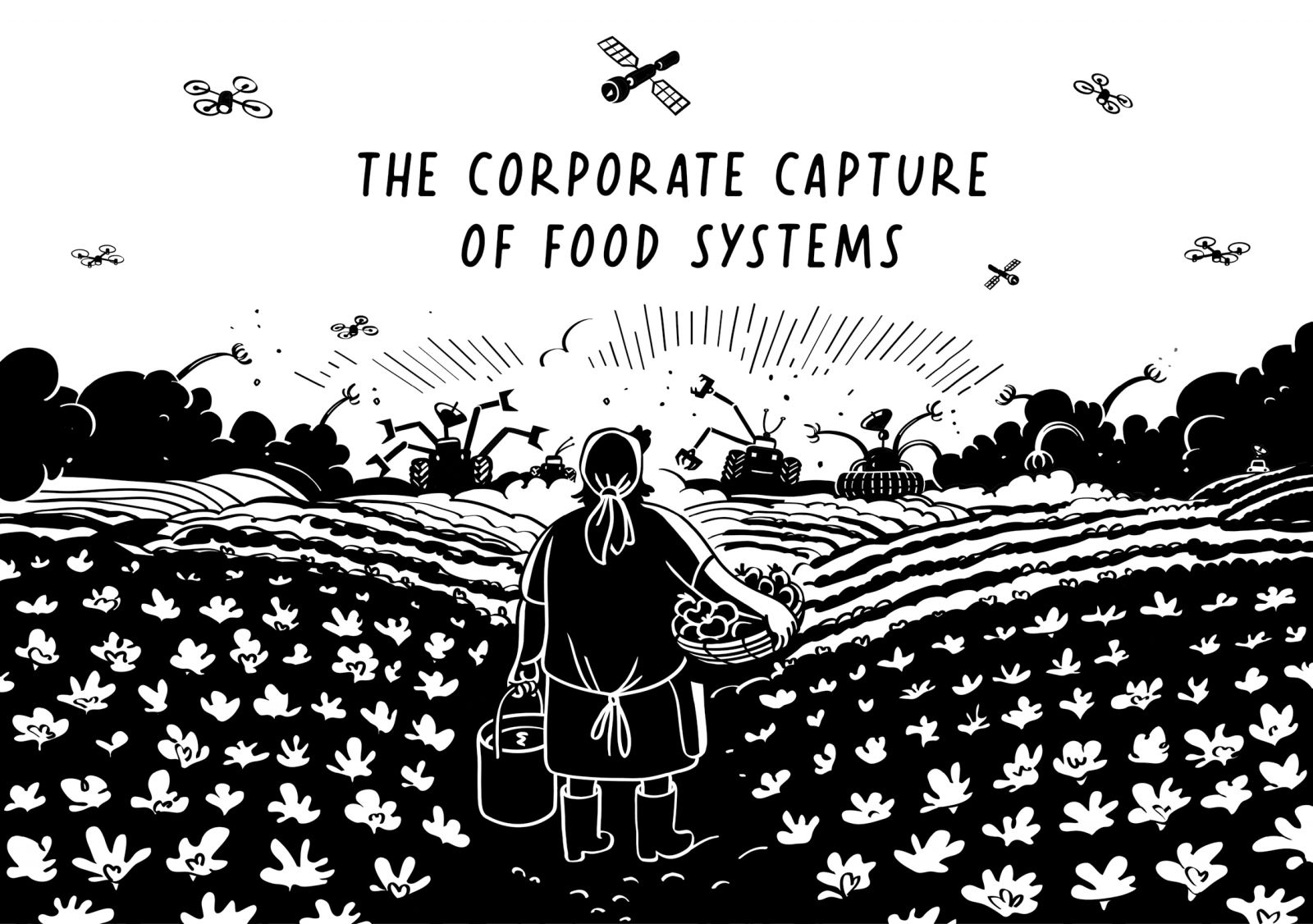
CORPORATE CAPTURE OF GLOBAL FOOD SYSTEMS ‘ THE COLLABORATION BETWEEN THE WEF AND UN FOOD  AGRICULTURE ORGANIZATION (FAO)

CORPORATE CAPTURE OF GLOBAL FOOD SYSTEMS ‘ THE COLLABORATION BETWEEN THE WEF AND UN FOOD  AGRICULTURE ORGANIZATION (FAO)

The Un / WEF Official Partnership was officially adopted 13th June 2019. With a Proviso to jointly  accelerate UN Agenda 2030 Global Goals across the world. (SDGs) Transforming Our Lives By 2030. Leaving No-one Behind- Everyone-Everywhere at Every Age. To collaborate Global Food Security * Transform Agri-food Systems. Resource Management * Digital Global Innovation * Public-Private Partnerships * Multistakeholder Capitalism

However there have been many critics that have raised multiple concerns primarily Civil Society Organizations about the Conflicts of Interests * The Influence of Private Corporation as whisperers in the ears of UN Agencies .This includes the Corporate Capture of the Global Food System and the UN FAO’s role in the Global Food Initiatives that include:-Strategic Partnerships with Corporations (a wide range of stakeholders) including UN Entities * Governments * Leaders of Civil Society and the Private Sector (The Mask they hide behind is (Eradicating Hunger- Poverty World Wide) Global Agenda 2030- SDG 1 and SDG2

The FAO (UN) works in a broader UN Framework in that of Food Security & Nutrition. Guiding Global, Regional and National efforts into Policy & Decision making. And encourages Multistake-holderism dialogue, developing common approaches to Global Food Systems. Supporting UN Member States to create coalitions of Public-Private Actors to foster Agri-food System Transformation. The deepening of institutional engagement as to Global Challenges such as Climate Change – Health – and the coined phrase ‘Sustainable Development

The WEF-UN Collaboration (Partnership) with the FAO (UN)..In 2022 they signed a Letter of Intent to facilitate the channeling of the Private Sector resources towards Transforming Agri-food Systems worldwide. The WEF launched the Food Innovation Hubs Global Initiative with FAO (UN) as the Collaborator. Leveraging Market Based Partnerships with Public-Private and Civil Society Partners to Scale Up Innovations

Critics have reported that the UNs growing collaboration with the WEF is a platform for Transnational Corporations that allows ‘Global Corporate Capture’ and a dialogue of  Global Decision Making. 240 Civil Society Organizations condemned the 2019 WEF-UN Partnership in an Open Letter stating that it ‘Delegitimizes the UN and weakens the role of UN Member States in Global Decision Making – Increasing the influence of corporations, promoting industrial, technological focused solution to Food Security which risks harming small scale farming practices, causing socio-economical problems. Favoring Corporate Interests over that of vulnerable populations-Threatening Human Rights.

Giving disproportionate power to Corporate Interests, undermining  the Democratic State Nature of the UN as it was originally set out to be. With the WEF & UN public-private relationship increasing investment in Agrifood systems, aborting traditional farming. Collaborating on Data & Digital conditions that produce WEF/UN Initiatives Eg: (One Map & the Future Market Place Playbook) With the FAO (UN) and WEF Co-publishing a White Paper titled ‘Transforming Food Systems for Country Led Innovation’

The WEF/FAO (UN) Food Summit and the Digital and Data Coalition. The WEF long standing relations with UN Agencies. The Alignment of Food Systems Transformation.  Inclusive Partnerships with common goals. The common goal of Transforming Global Food Systems. Providing Data and Stats crucial for informing Policy and Tracking Progress in the Transformation of Global Food Systems

Partnerships that are focused on attracting Investment for the Transformation of Global Food Systems, this includes how Food is Produced, Distributed and Consumed globally. The total destruction of the Free-market Enterprise Innovated Economy (The Freedom To Choose). Multistakeholder Capitalism Klaus Schwabs baby (600 Page Global Redesign Initiative 2010) Produced and adopted post the 2008-2009 World  Financial Recession. Adopted by Governments worldwide

Critics state that this approach shifts Economic Governance away from Competitive Markets towards a model of Self Appointed Group of Corporate and Political Elites. There are also many critics that view the annual DAVOS gatherings as an Undemocratic Opaque Governance Venue where powerful political and corporate leaders make decisions without accountability to the public they represent in UN Member Nation States thus diminishing National Sovereignty

Never let a Good Crisis Go To Waste. Large Corporate Interests that prioritize Conformity over Disruption. The WEF is accused of ‘Crony Capitalism’. Where Corporations use their influence to lobby for favorable regulations and protectionism through Legislations at the expense of a genuine Free-Market enterprising Innovative Economy. Corporations accused of Green Washing (ESG’s)

Initiatives such as the Great Reset proposed by the WEF, advocating for the restructuring of the Global Economy. The lack of Democratic Engagement within UN Member Nation States and Beyond -Globally that do not reflect the interests of UN Member State or Global Population interests but those of the Economical /Political Elite. The Stakeholder Capitalism model seeks to shift responsibility beyond shareholders to a broader group of stakeholders has been criticized as rebranding of the worlds economy. And the Erosion of National Sovereignty

The increasing influence of the WEF over UN Nation State policies and the erosion of National Sovereignty is not without serious concern. The WEF pushing for Global Governance Models that by-pass Nation State Legislatures without civil societies explicit consent. The WEF Global Digital Identification Systems, * Centralized Climate Policies * International Tax Frameworks all encroachments on Nation State Government and the voting public of the Sovereign Nation State. Decision making that cannot be challenged, hence the government is not held accountable by its voting  citizens

The WEF a strong powerful proponent of the Forth Industrial Revolution which encompasses Artificial Intelligence * Automation * Biotechnology being implemented even though populations worldwide have serious concerns about this push into a Technocratic Future of Controlling Forces of Compliancy. The WEF reporting its Vision ‘A Technology Driven Future that includes Mass Digital Surveillance which is being played out rapidly across the world eight now. AI Digital Identification Global Governance (Transforming Our Live by 2030. UN Agenda 2030 SDG 16.9 Everyone is to have a digital ID by 2030) Otherwise you wont be recognized as existing.

NZ participating in the WEF Pilot ‘Digital Regulations’. Without transparency. Did the Government share this information publicly? NO. Was there any public discussion- debate with  the population of NZ. No.  WEF mass digital surveillance, monitoring and a push for a ‘cashless society’. Digital Identity Systems. Government/Corporate surveillance restricting individual autonomy- freedoms- liberties. (Judith Collins Portfolio)

COVID 19 – The WEF played an increasing significant role in shaping Global Health Policies particularly during the COVID Pandemic. Collaborating with Organizations like the WHO (UN) and major Pharmaceutical companies (Big Pharma) to influence  Vax Policies, Digital Health Passes and Pandemic Preparedness Strategies. Concerns have been raised about the WEFs role in promoting policies that benefit Bif Pharma at the expense of transparency and Public Choice. The rapid push for vaccine mandates and Digital Health Passports seen by some as an over-reach prioritizing Corporate Interests over Individual Freedoms

The WEF and the UN have positioned themselves as a global force, with zilch accountability to National Sovereignty and the people whom vote political parties in. This empowers a small global powerful elite to shape the Global Future that do not align with the broader interests of Humanity. This is a global concentration of centralized power (Top Down and Bottom Up) that poses a huge risk to our personal- individual freedoms. Where Governments engage with the WEF /UN behind closed doors when they collaboration – plan to implement the Transforming Of Our Lives before 2030. (Leaving No-One Behind..Everyone..Everywhere.. At Every Age)

We No… What They Are Doing.. They Know- We know what they are Doing.. But they still keep on Doing it.. Yet there is a deafening Silence in the public Arena as the UN Member State Puppets implement ‘Transforming Our Lives By 2030’ Locking us into a Digital Prison. Industrial Corporate Global Food Systems and Smart City Surveillance-Monitoring-Facial Recognition.

WakeUpNZ.. RESEARCHER: Cassie


...

Uncategorized Blog Posts View all Categories

THE GLOBAL VACCINE SUMMIT SEPTEMBER 2019

The Global Vaccination Summit was held in Brussels on September 12, 2019. It was co-hosted by the European Commission and the World Health Organization (WHO). The summit aimed to accelerate global action against vaccine-preventable diseases and combat the spread of vaccine misinformation. It brought together around 400 participants, including political leaders, health professionals, and representatives from various organizations.

Here’s a more detailed breakdown:

Key Goals:- The summit focused on increasing vaccine confidence, boosting research and innovation in vaccines, and demonstrating the EU’s leadership in global vaccination efforts.

Participants:- The event included political leaders, scientists, medical professionals, representatives from the pharmaceutical industry, philanthropic organizations, and civil society.

Outcomes: – The summit led to the development of “Ten Actions Towards Vaccination for All” and highlighted the importance of global collaboration to address vaccine-preventable diseases.

Context:- The summit took place against a backdrop of rising measles cases and increased vaccine hesitancy. The WHO had recognized vaccine hesitancy as a global health threat earlier in the year.

Global influenza pandemic

The world will face another influenza pandemic – the only thing we don’t know is when it will hit and how severe it will be. Global defences are only as effective as the weakest link in any country’s health emergency preparedness and response system.

WHO is constantly monitoring the circulation of influenza viruses to detect potential pandemic strains: 153 institutions in 114 countries are involved in global surveillance and response.

Every year, WHO recommends which strains should be included in the flu vaccine to protect people from seasonal flu. In the event that a new flu strain develops pandemic potential, WHO has set up a unique partnership with all the major players to ensure effective and equitable access to diagnostics, vaccines and antivirals (treatments), especially in developing countries.

https://health.ec.europa.eu/document/download/3a92fc71-fd94-4c05-be6a-188f01f42352_en#:~:text=To%20address%20these%20challenges%2C%20the,and%20improving%20access%20to%20healthcare.

GLOBAL VACCINATION SUMMIT BRUSSELS 12TH SEPT 2019  EUREOPEAN COMMISSION.  WHO

RESEARCHER: Cassie

WakeUpNZ

...

THE DANGERS OF THE GENE TECHNOLOGY BILL – WE MUST STAND UP AND CALL A HALT TO THE GENE TECHNOLOGY BILL BEFORE ITS TOO LATE ‘ PROTESTS TOMORROW NZ WIDE. KEEP NEW ZEALAND GE FREE. Make A Stand …

Replaces the 1996 Hazardous Substances and New Organisms Act. There is a reason why Genetic Engineering has been restricted to Containment Labs- because the potential serious risks if out in the environment. The Govts Health Committee received many thousands of submissions that have voiced serious concerns over the risks if this legislation is passed. Of course the Govt will tell  NZrs the Bill of passed will enable the safe use of Gene Technologies (Gene Editing) . There are most certainly serious risks to those farming crops that are GMO Free and Organic farming of Crops with cross pollination from GMO crops to other crops that are not GMO grown

The Health Select  Committee Review and Consultation Process reported back to Parliament 10th October 2025 recommending the Bill is passed with some amendments. However there is political uncertainty due to the lack of certainty within the current government. The Govts stated goal is to pass the Gene Tech Bill into legislation by the end of this year. If the Bill passes Royal Assent into Legislation NZs good reputation for GE Free and Organic farming could go down the toilet. This could also bring large Agri-tech and Bio-Tech companies to New Zealand, many of them have headquarters overseas, may well see NZ as a golden opportunity for expansion and more profit (An untapped test bed for Genetic Engineering). Eeem well I wonder what negative impact that would have on our Export Sector in NZ. (And the livelihoods of our Farmers and Growers)

Some people (Farmers in NZ) may remember the US Monsanto now Bayer and the genetically engineered Roundup Ready crops that were sold alongside glyphosate herbicide,  with more chemical use and no yield value.  NZ Farmers and Growers have been able to help each other out with seeds, however GE Seeds are patented this is how large seed companies make their big profits.. (Seeds and Fertilizers-herbicides) Only a few major corporations in the world have the world in their hands when it comes to selling seeds on the global markets.

There has been notable  serious opposition to GM Crops – food security- Safety when it comes to the health of Humans and Animals. NZs opposition to Genetic Engineering goes back to the 1970s when there was serious concerns about safety and contamination. In 1996 the Hazardous Substances and New Organisms (HSNO) Act was passed, creating the Environmental Risk Management Authority (ERMA) to strictly control all Genetic Modification activities

The NZ Royal Commission in year 2000 on Genetic Modification recommended that NZ should Proceed With Caution and Avoid Releasing GE Organisms into the Environment. Then came the very restrictive Containment Labs for GE Research in NZ. In 2014 The High Court ruled that Gene  Modification MUST stay Regulated. (As we must make sure it does stay Regulated. Then came the CornGate Scandal (GM Corn Seeds) that were suspected of contaminating crops in Gisborne and Pukekohe (Hence the Royal Commission on Genetic Modification)

But that wasn’t the end of it because there was also ‘Operation Pacific- Maize grown from imported seeds that tested positive for GE contamination. The containment was destroyed at the cost of $500,000. Just imagine how much more it could have potentially cost NZ when it comes to Health & Safety when it comes to our Food System – Health of Kiwi’s and our Domestic and Farm Animals. The Government cannot promise (guarantee Health & Safety of  the use of Genetic Modification (Genetic Engineering). Once the damage is done and GM cross pollination (contamination) happens the high risk is that it cannot be undone.

Reference to Prof David Williams, he was working on Gene Therapy at UCLA. He warned the farmers about the Gene Tech Bill saying it was based on false assumptions referring to precision and safety (Well documented ‘Off-Target Effects of CRISPR & other Gene Editing Tools) This included chromosomal deletions  & genomic instability). He also warned that loosening NZ laws could wipe out export premiums that farmers receive for GMO Free Livestock and Produce

Williams also warns that loosening New Zealand’s laws could wipe out the export premiums farmers receive for GMO-free livestock and produce. Once released GE Organisms into the environment they cannot be contained (Be recalled). There are no guarantees there will be no mutations in livestock.  We are totally reliant on the Soil for Everything, contaminating  the soil with these organisms is an extremely serious problem when it comes to Health-Safety- Food- Farmers Livelihoods and our Export Market. Let alone the feeding of our own population in NZ. Contaminations incidents have happened in other countries this has been common and very costly. GE Farming involves significant risks economically, environmentally and lets not forget Health Risks

Some of the risks are increased reliance on specific herbicides can lead to superweeds.. Insect resistant crops. Long term ecological impacts OF GE Organisms are not fully understood, therefore carries risks with unforeseeable consequences for the environment. There have been studies  that have raised concerns about the long term effects of consuming GE Foods this includes Liver and Kidney damage, immune system issues and increased risk of tumors

Consumer choice and transparency  and the deregulation of GE may well reduce transparency, making it difficult for consumers to identify, choose NON GE or Organic Products. There are concerns as to mutations in animals. Major concerns fall into the following categories- Environmental * ecological * Economic & Trade * Health-Safety-Social Risks. NZ has a good reputation for its Clean Green Image  this could be undermined by the widespread adoption of GE Farming, lead to lost Export Markets

How are Non GE and Organic Crop and  Non GE  Crop Farmers protected if there crops are contaminated by GE Organisms. There have been instances overseas where farmers with contaminated crops were sued by the patent holding corporation for intellectual property infringement. (Even though this was accidental). Oh yes, this is corporate control. GE Seeds often tie farmers into multinational corporations for seeds and chemical supplies causing a dependency on multinational corporations.

There have been safety studies  where there has been raised concerns about the potential long term effecrs of consuming GE Foods, including Liver & Kidney damade, immune system issues, increased risk of tumors  (Animal Study Research). Another serious concern is the removing of mandatory labeling for certain GE Foods, making it difficult for the consumer to identify GE Products. This limits choice by Non transparency

Will this also lead to the creation of GE Animals  this risks involving invasive procedure, a high rate of developmental; abnormalities, un anticipated welfare issues in cloned offspring. Of course there are ethical concerns when it comes to the manipulation of an organisms genetic makeup including those related to intellectual property (Patenting Life Forms) Playing with Nature… Eeem Those that Control the Food Control The People. (For me the everlasting NO Trust Bio Tech COVID- Experiments-)

NEW ZEALAND WIDE PROTEST TOMORROW.. SATURDAY 29TH NOVEMBER 12- 2PM KEEP NZ GE FREE. …See the Poster on my facebook for locations across NZ.

WakeUpNZ. Researcher Cassie


...
Carol Sakey
TECHUncategorized

THE POTENTIAL RISKS OF GENETIC ENGINEERING IN AGRICULTURE (1)

THE RISKS POSED ARE AS FOLLOWS:-  

(1) Negative Health effects from new Allergens or Toxins  (1a) Environmental risks like the creation of “superweeds” and resistant pests,   (1b)Reduced biodiversity, and ethical concerns about interfering with nature. (1c) Concerns as to the potential risk as to antibiotic resistance from genetically modified organisms   (1d)(GMOs) and the long-term, unknown consequences of genetic modification on ecosystems and human health.

(2)Health & Safety Concerns:-

(2a)Allergic reactions: Genetic engineering could introduce new allergens into the food supply. 

(2b)Antibiotic resistance: Genes for antibiotic resistance from GM crops could potentially transfer to humans or animals, contributing to antibiotic resistance.

(2c)Unknown long-term effects: The long-term health impacts of consuming GM foods are not fully understood.

(2d)New toxins: Some genetically engineered crops could produce new toxins

(3)Environmental Risks:

(3a)”Superweeds” and “Superbugs”: Herbicide-resistant crops can lead to the development of herbicide-resistant weeds, and crops engineered to produce insecticides can lead to the evolution of pesticide-resistant insects.

(3b)Gene transfer: Genes from GM crops can spread to wild or weedy relatives through cross-pollination, creating new and potentially invasive plants.

(3c)Harm to non-target organisms: Pollen from some GM crops can be toxic to beneficial insects like the monarch butterfly.

(3d)Biodiversity loss: The promotion of monoculture and the spread of GM crops can lead to a reduction in crop biodiversity and impact the resilience of ecosystems.

(3e)Increased chemical use: Despite promises to reduce pesticide use, some GM crop systems can increase the use of chemical herbicides, leading to soil and water degradation.

(4)Ethical and socioeconomic concerns:-

(4a)Interference with nature: Some people have ethical objections to altering the genetic makeup of organisms.

(4b)Dependence on large companies: Genetic engineering can increase the dependence of developing countries on large seed companies, potentially giving them control over food production.

(4c)Loss of genetic diversity: The push for genetically uniform crops can lead to a loss of valuable traditional varieties.

(4d)Unpredictable interactions: Genetically engineered plants could have unforeseen interactions with the environment, potentially becoming invasive and displacing native species.

WakeUpNZ… RESEARCHER: Cassie


...

GENE THERAPY ‘ PFIZER’- ASTRAZENICA- THE NZ NEW GENE THERAPY BILL 2024…

Pfizer adheres to NZ Regulations for Medicines, this includes ‘Gene Therapy’. NZ is focusing on its Gene Technology Regulations to facilitate Research *Development * Manufacture of New Therapies. Pfizer compliancy is bound by NZ Regulations for the Pharmaceutical Industry that covers all aspects of Medicines, including emerging fields eg:- Gene Therapy. With NZ Govt updating its Regulations to make it easier for the Medical Professions, Scientists to develop Gene Therapies including Gene Technology.

NZ Govt moving from a Restrictive System to one that facilitates Research and Access to Treatments. Pfizer’s role is well known as being focused on Gene Therapy Research and Development internationally. Pfizer trials on Gene Therapy would need Medsafe approval for local trials in NZ. Late 2024 early 2025 NZ Govt began over-hauling its Gene Therapy Regulations to replace the 30yr Hazardous Substance and New Organism (HSNO) Act

The new Gene Technology Bill is modeled on Australia’s Gene Technology Act. A new Regulator will be established with the Environmental Protection Authority (EPA) to oversee the field. This will allow for Fast Tracking of Gene Therapies. Hence Pfizer’s most prominent activity to Gene Technology in NZ has been to supply MrNA COVID 19 Jabs, which have received Provisional Approval by MedSafe…(MedSafe is NZs Medicines Regulator)

Alexion is an AstraZeneca subsidiary that acquired a portfolio of pre-clinical Gene Therapies from Pfizer in a Global deal. NZ Researchers are currently conducting clinical trials on Gene Therapies. NZs growing involvement in this field (even prior to the latest Legislative changes). NZs  Worlds First Trials – the Clinical Research Center using CRISPA in NZ. The Malaghan Institute of Medical Research running NZs first CART-Cell Trial- Genetically modifying a patients Immune Cells

Auckland University led Trials on Gene Therapies. Research collaboration in NZ Clinical Research Centers- Universities- Hospitals are already collaborating to accelerate Genetic Research and Advanced treatments using Gene Therapies for companies like Pfizer a Path to Gene Therapies in NZ. Gene Therapies include modification of Plants etc., This is backed majorly by the National and ACT Party. Reported to be a permissive approach to Gene Modification of Risks & Benefits.

Gene Technology involves Plants * Animals  * Humans * Micro-organisms = DNA. Also described as Genetic Engineering or Genetic Modification. GMOs  are organisms that have undergone the process or inherited modification of Genes. Gene Technology from a Technical perspective can involve *Modification * Removal & Multiplication * Relocation of a Gene within an organism- or the Transfer of a Gene from one Species to another

The Genetic Modification of Crops to increase production is reported to improve resistance to environmental conditions (Adaption to Climate Change referring to the Agricultural Industry)  The Gene Technology 1996- 2024 Approach- Gene Technology releasing GMOs into the Environment is heavily restricted under Law- although heavily restricted its still possible with Regulations approval

The primary barrier of using Gene Technology and GMOs in the Hazardous Substances & New Organisms Act 1996. Amendments were made in 2000 to incorporate recommendations made by the Royal Commission on Genetic Modification which meant very little changed as far as the Law is concerned. The Law at this present time before new legislation kicks in is:-

A GMO may not be imported * manufactured * developed * field tested or released into the environment other than in accordance with an approval. The  current ACT does not provide a wholesale ban on the release of GMOs outside a Lab setting in NZ. Although it does make it subject to EPA approval. The using GMOs inside Labs  are strictly regulated. GMOs can only be implemented into a developed or tested within a containments facility (A Controlled Lab) approved by the Ministry Of Primary Industries (MPI)

Operated in accordance with MPI and EPA Standards and other legal barriers such as approval from authorities in NZ. The Bio-Security Act 1993 prohibits Importation * Release * Propagation of GMOs that are not approved for Important by the current legislation (HSNO ACT). This is enforced at the Border by MPI

Between the HSNO Act and other Environmental Legislations this has been an area of tension in NZ, as a result Court decisions and some Local Authorities consider they have the power under the Resource Management Act (RMA) 1991 to regulate the use and release GMOs through Policy Statements and Plans. There are Bio-Security hurdles as to the use of Gene Technologies, therapeutic products that are GMOs which are regulated by Medsafe under the Medicine Act 1981. The Human Tissues Act 2008 which contains general prohibition on Trading in Human Tissue * Cells * Blood * Bone Marrow and other Body Parts

Australia’s Hybrid Approach is likely to be adopted in NZ. RMA Restrictions removed and the HSNO Act amended. NZ Regulators will utilize overseas regulations as to its activities. Automatic authorization will be granted for Human Medicine – Regulations for the New Gene Technology is expected to be in place by the end of 2025.. The NZ Omnibus Bill seeks to use Gene Technology in NZ by establishing a new Regulatory regime (Gene Technology Bill 2024)

AstraZeneca- Pfizer $1 Billion Gene Therapy deal with Astrenica’s subsidiary Alexion- a portfolio of pre-clinical Gene Therapy and Technologies from Pfizers deal. Alexions Global Pre-clinical Research is conducted globally. Eg 2019 collaboration with NZ Pharma focusing on discovery, research up to pre clinical stage trials. The Global Pre-clinical Candidate in 2024 is called ZP1000468 developed by Alexion and NZ Pharma prepared for Clinical Trials.

Watch for the partnership announcements as to future collaboration that could lead to new clinical trials in NZ. Alexion has had interactions with NZ Pharmaceutical Regulatory body Pharmac for its approved medicines. 2019 Alexion announced collaboration with Danish BioTech company..NZ to lead certain therapies. NOTE:- Local Clinical Trial Websites.. Research Networks * PCRN * Momentum Clinical Research * Clinical Trials NZ

NZ Gene Therapy Law aims to create opportunities for companies like Pfizer by modernizing regulations similar to Australian Gene Technology Regime. However there are Risk when it comes to Gene Therapies. And Australia does refer to those risks and the consequence involved. Concerns about integrating Vectors. Leading to severe health problems. Long term follow-ups are crucial. There are many uncertainties. Risks and Uncertainties

WakeUpNZ.. RESARCHER: Cassie

...