PART 4: NZ LED LABOUR GOVERNMENT AND ITS APPEASEMENT WITH NAZI GERMANY ‘THE BRITISH REJECTED NASH’S COMPLICATED PROPOSALS’
The Labour Govt was elected in 1935. They quickly tried to diversify International trade. At the end of 1936 the Finance Minister Walter Nash travelled to London. He failed at convincing Britains Politicians and Bankers into accepting new trade deals with New Zealand, so he made an unscheduled visit to Germany, where he was made most welcome by Hitlers Regime . Nash and his Nazi counterparts struck a trade deal * by the end of 1937 NZ was exporting 500 tonnes of Butter and large amounts of wool to Nazi Germany
Back in NZ the Trade Deal was welcomed with much delight. Mark Fagan the leader of the Legislative Council, the Upper House of Parliament said that the agreement had “already brought about a better understanding between New Zealand and Germany” and thanked Walter Hellenthal for his efforts to improve relations between NZ and Nazi Germany.
July 1937 the Trade Agreement was finalized by the Minister of Labour Tim Armstrong whom had toured Germany, visiting factories, talking with leaders of Germanys trade unions, Armstrong reporting that the German peopled appear to be very contented under Hitlers rule. Finance Minister Walter Nash and his wife departed NZ for London in 1936 where his proposals for Trade deals were rejected. He then went onto Germany where he negotiated the Trade Deal with Hitlers Regime.(Photo: Evening Post, 13 October 1936. Alexander Turnbull Library, Wellington, New Zealand. /records/19484061)
Walter Nash was also the Minister for Customs as well as Finance in the late 1930’s. He had the responsibility for assessing applications for would be immigrants to New Zealand
Walter Nash was minister of customs as well as minister of finance in the late 1930s, and it was the Ministry of Customs that had responsibility for assessing applications by would-be immigrants to New Zealand. Nash’s Policy 1939 replying to a letter to NZs quakers who wanted the country to accept more Jewish refugees.. Nash claimed that “there is a major difficulty in absorbing these people in our cultural life”
However NZ Immigration Policy had long valued assimilation. British were preferred as migrants because it was said they blended into NZ Society better than other groups. But Nash found it harder to assimilate the Jewish people into NZ than other peoples from Europe. Since the 19th century Jewish people had been important to NZs political, commercial and cultural life. For example Julius Vogel was a practicing Jew, but he became the Premier of the Colony in 1873.
Haldenstein, Myers and Nathan families built business empires. Thus Nash’s claim that he found it hard to accept Jews into NZ is dubious we have to wonder whether there was another reason (Its questionable). Was he fearful that is he welcomed too many Jewish refugees this may antagonize the Nazi Regime and imperil their trade deal.?
Then Nash left the processing of applications for immigration permits to senior officials at the Ministry Of Customs. This was managed by Edwin Good, he held the position until his retirement in 1946. In 1939 he wrote a memo for Ministry Staff in which he stated that “Non-Jewish Applicants are regarded as a more suitable type of Migrant”
The Evening Post in 1938 published a tribute to Walter Hellenthal who was taking leave of absence from his post in NZ. The article described the “ many luncheons, dinner parties, cocktail parties that the Wellington German Club had organized to make Hellethals stay in the city welcome. The Evening Post listed the hosts of these parties. Edwin Good appeared on its list. Good was involved in the German Club, an organization saturated with Nazism and Antisemitism. Therefore its surely questionable that he may have had personal, ideological reasons for keeping Jewish people out of New Zealand?
When the Jewish refugees reached NZ it did not end there, 1939 Jewish refugees were often considered potential or actual agents of the enemy. The same Jews whom, had been earmarked for execution (extermination) by the Nazi’s were suddenly suspected of being Nazi Sympathisers
During the war years Jews also came under pressure from professional groups, who worried about competition from highly skilled migrants. The New Zealand sections of the British Medical Association campaigned against refugee doctors, arguing that they should not be allowed to practise here. In response, the government made it compulsory for refugee doctors to do no less than three years of “training” at the Otago Medical School.
The Returned Services Association repeatedly called for the mass, indiscriminate internment of all “enemy aliens”, and claimed that they were taking jobs that should be kept for soldiers serving abroad.
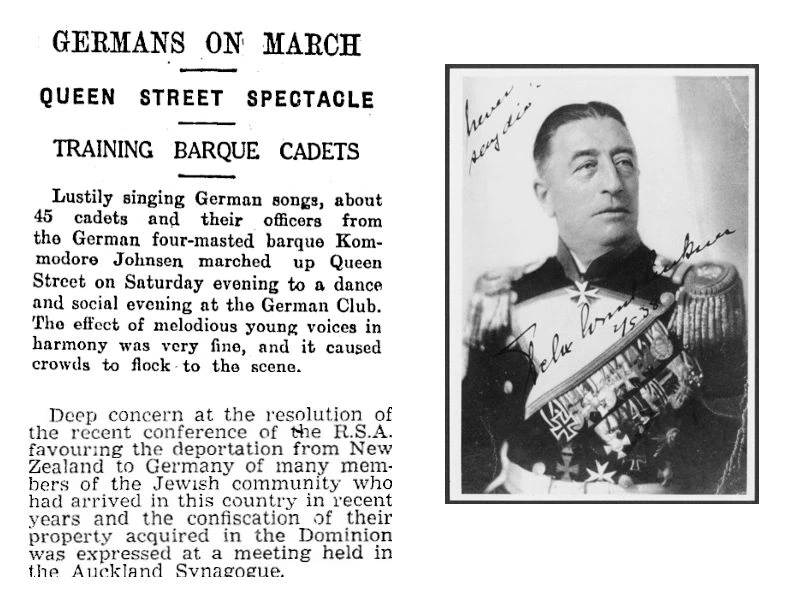
In June 1945, when the war had been over for only a few weeks, and images of Nazi death camps like Auschwitz and Dachau were shocking the rest of the world, a national conference of the RSA called for the deportation of all “enemy aliens” who had arrived in New Zealand from 1939, and for the confiscation of any wealth they had acquired during their time in the country. The RSA’s demand would have forced Eva Brent and many other Jews to return to a divided, hungry and ruined Germany.
A number of newspapers supported the RSA. The Dominion argued that the refugees had been “given shelter during a storm”; now that the storm was over, they should “go home”.
WakeUpNZ
RESEARCHER Cassie
-

-
Wednesday - January 28, 2026 - Uncategorized
(147)




Leave a Comment